The Red Room of Beliaghata
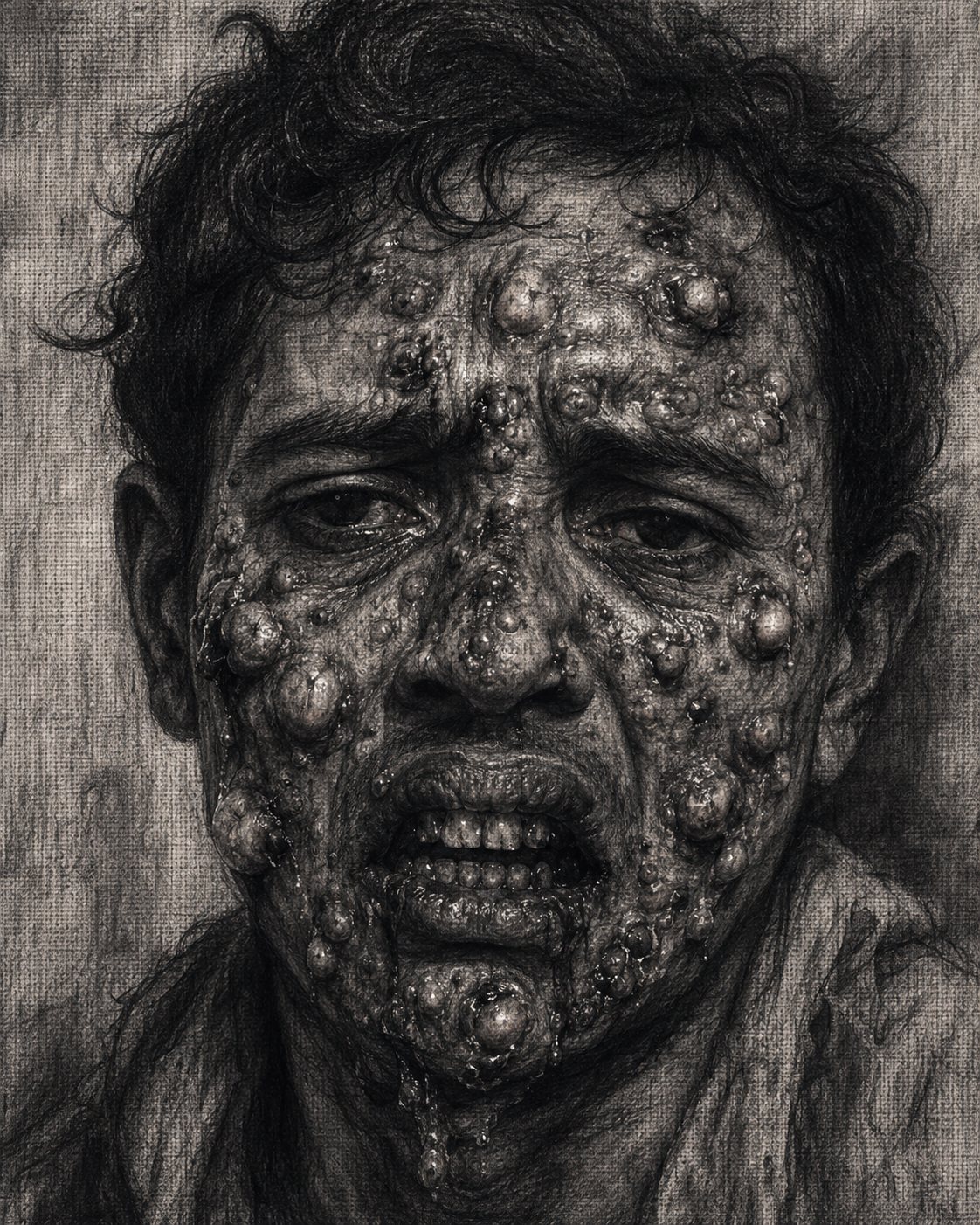
THIS IS A WORK OF FICTION
The parcel arrived at Beliaghata just as the electricity went out and the whole lane made the same disgusted sound, as if Calcutta itself had bitten into a bad green chilli.
One moment there had been tube light, ceiling fan, the wet shuffle of evening traffic. Next moment, blackness. Then came the city’s replacement orchestra: pressure cookers sighing behind iron grilles, somebody’s inverter coughing once and giving up, boys shouting from a tea stall, a tram bell faint and improbable from somewhere toward Sealdah, the high thin whine of mosquitoes discovering democracy.
In the lane below, rainwater stood in the potholes with a skin of oil on it. The posters on the wall—tuition classes, missing cat, a councillor’s smiling face peeling at the chin—hung damp and defeated. A taxi tried to reverse between a vegetable cart and a scooter, failed, and honked at destiny. At Naren’s tea stall, three men argued whether the power cuts had been better under the Left, worse under the present people, or simply eternal, like diabetes and aunties.
Mrinalini Dutta stood on the first-floor landing of 17/2 Nilmoni Lane holding a candle in a steel tumbler. She had come down to ask whether anyone had seen the milkman’s boy, because her mother’s tea, without milk, was treated in their household not as a beverage but as evidence of civilizational collapse.
Instead she found a courier boy in a plastic raincoat, sweating so hard his face shone in the candlelight.
“Dutta?” he asked.
“There are six Duttas in this building,” Mrinalini said. “You have to develop ambition.”
He was too tired to smile. He held up a small wooden box wrapped in brown paper and plastic tape. On the top, in purple ink, was written:
DR. S. DUTTA
17/2 NILMONI LANE
BELIAGHATA, CALCUTTA
Below that, in smaller letters, almost rubbed away:
Keep sealed. Do not expose to heat.
“There is no Dr. S. Dutta here,” she said.
The courier looked at the stairwell, the dark mouths of the flats, the damp walls flaking in gray curls like old fish scales. “Madam, please. Just take. I have twenty-nine more.”
“Then deliver correctly twenty-nine times.”
From upstairs, her mother called, “Mrin! Milk?”
The courier shifted the box. Something inside clicked faintly.
“Maybe old owner,” he said. “Maybe your father?”
“My father was not a doctor.”
This was true, though like many family truths it had suffered from editing. Her father, Shambhu Dutta, had been a laboratory attendant at the old infectious diseases hospital off Beleghata Main Road. In the family version he had “worked in medical service,” which sounded cleaner, more salaried, less close to other people’s fever. He had died twelve years ago with no pension worth naming, two unpaid loans, and one locked steel trunk that Mrinalini had never opened because grief, like a municipal file, can be postponed indefinitely if nobody asks for the correct form.
The courier boy sneezed. Not a large sneeze. A small, wet, exhausted one. He apologized and wiped his nose with the back of his hand.
Mrinalini stepped back.
From the ground floor, old Mrs. Lahiri opened her door one inch. “Who is dying?”
“Nobody, mashi.”
“Then why shouting?”
“Parcel confusion.”
“Keep it downstairs. Thieves will take. Then no confusion.”
That settled it in the magnificent Bengali way: by introducing a worse possibility. Mrinalini signed, because the candle was melting onto her fingers and because in Calcutta a parcel left in the stairwell becomes public property, legal philosophy, and possibly footwear within ten minutes.
The box was surprisingly cold.
Even through paper and tape, in a load-shedding evening that had turned every human being into a leaking clay pot, the wooden box felt as if it had brought its own winter.
She carried it upstairs.
Her mother, Bela, sat on the cot near the window, white hair loose, one hand resting on her knee. After her stroke, the left side of her face had settled into a permanent expression of disappointed skepticism.
“Milk?” Bela asked.
“No milk. Parcel.”
“Can I put parcel in tea?”
“No.”
“Then why telling me?”
Mrinalini placed the box on the dining table, between the plastic flower vase and the stack of unpaid electricity bills. The candle flame leaned toward it.
The cold seemed to thicken in the room.
Across the narrow courtyard, the Mukherjee family’s inverter had succeeded, and their flat glowed with pale blue emergency light. Their son, Arko, was visible at his desk, preparing for another exam that would qualify him to prepare for another exam. Contemporary Bengal had perfected this system: a generation of young people turned into coaching-center incense, burned slowly before the altar of government vacancy.
Mrinalini watched him for a moment and felt the old bruise of her own life. She taught history at a private school that paid late and called it “institutional adjustment.” She was forty-two, unmarried, useful to everyone, desired by nobody who had stayed. Once she had wanted to leave Calcutta. Then her father died. Then her mother fell. Then one year packed itself on top of another like damp newspapers, and the city, tender jailer that it was, kept saying, just one more month.
The parcel clicked again.
Bela said, “Open and see.”
“It says keep sealed.”
“Then why send?”
This was also true.
The tape was old-fashioned, brown and cloth-backed beneath the newer plastic wrapping. The address label had been pasted over something else. Mrinalini held the candle closer. Under the purple ink she could make out a printed line:
CALCUTTA PRESERVATION SOCIETY
PRIVATE ARCHIVAL MATERIAL
She did not open it.
That was her first good decision.
Her second, worse one came an hour later, after the power returned with a violent blink and the ceiling fan chopped the heavy air into usable misery. She phoned the courier number. It rang, crackled, and died. She called again. Nothing.
At nine-thirty, there was a knock.
Not the polite knock of a neighbor. A dry, official knock.
On the landing stood a man in a cream shirt darkened under the arms, holding a leather folder. He was perhaps fifty-five, clean-shaven, with a soft, scholarly face and eyes that had not slept.
“I am looking for a parcel delivered here by mistake,” he said.
“Who are you?”
“Dr. Supratik Dutta.”
She said nothing.
The name sat between them, almost innocent.
He smiled with effort. “Not your relative. Dutta is not rare. In Bengal we have flooded the market.”
Behind him, Mrs. Lahiri’s door opened its usual inch.
“What parcel?” Mrinalini asked.
“A wooden box. Brown paper. It contains historical medical material. Very fragile.”
“Historical how?”
He looked at the open crack of Mrs. Lahiri’s door, then back at Mrinalini. “May I come in?”
“No.”
His smile thinned.
From inside the flat, Bela called, “Who?”
“Wrong man,” Mrinalini said.
“I understand your caution,” Dr. Dutta said softly. “But this is not an item for domestic storage.”
“You should have told your courier.”
“I did not send it by courier.”
That sentence took the air out of the stairwell.
He must have seen her face change, because he lowered his voice.
“Please. Where is it?”
“Who sent it?”
“I don’t know.”
“Then how do you know it is yours?”
He hesitated.
A tiny movement. A man stepping around a hole in the pavement only he could see.
“It was meant to come to me,” he said.
“Meant by whom?”
Before he could answer, someone below screamed.
Not a film scream. Not decorative. A raw, astonished bellow, followed by the metallic crash of a tea glass hitting the lane.
Mrinalini and Dr. Dutta ran down together.
At the tea stall, the courier boy was on his knees in the rainwater. His plastic raincoat had slipped off one shoulder. Naren stood behind the counter with both hands raised, as if surrendering to a police raid.
The boy’s face had swollen.
It had not merely reddened. It had become intensely, brutally red, the color of fresh sindoor ground into wet flesh. Across his cheeks and forehead stood round, raised blisters, each the size of a pea, some already larger, tight and shining under the stall’s battery lamp. His eyelids were puffing shut. His lips had thickened.
“Ma,” he said, though his mother was not there. “Ma, burning.”
The men who had been arguing politics now backed away from him with unified national discipline.
“Food allergy,” one said.
“Chemical,” said another.
“Possession,” Mrs. Lahiri announced from the building entrance, arriving faster than her arthritis normally permitted.
Dr. Dutta pushed through. He crouched, then stopped before touching the boy.
“Did you open anything?” he asked.
The courier boy panted. “No, sir. Only boxes. Many boxes.”
“Which boxes?”
“Yours.”
“I did not send—”
The boy screamed again and clawed at his face. Mrinalini caught his wrists. His skin was hot now, wildly hot, and the blisters under her fingers felt firm, alive with pressure.
“Don’t scratch,” she said uselessly.
His eyes rolled toward her. “It looked at me.”
“What did?”
“Inside.”
Dr. Dutta stared at Mrinalini.
The lane, which had always specialized in spectators, filled at once. People came to doorways, balconies, windows. A man recorded with his phone until Naren slapped it from his hand. Somebody shouted for an ambulance. Somebody shouted not to call an ambulance because they would take everyone. Somebody else shouted that nobody took anyone in this city unless money was shown first.
Then the courier boy vomited into the gutter, and a red foam bubbled on his lips.
That was when the first woman touched her own cheek and said, “Why is it burning?”
By midnight, the lane had divided into those trying to flee and those trying to prevent others from fleeing.
The police came and left after arguing with the hospital over the phone. An ambulance arrived without enough fuel. The driver refused to enter the lane. Two young men carried the courier boy out on a broken charpoy. By then his face had become a swollen mask of blisters, his own features buried under a red, furious geography.
Dr. Dutta remained in Mrinalini’s flat, not by invitation but by necessity. He had washed his hands three times at the kitchen sink and was now standing before the wooden box on the dining table.
“You know what it is,” Mrinalini said.
“I know what it may be.”
“That is a doctor’s cowardly sentence.”
“I am not that kind of doctor.”
“What kind are you?”
He looked at the box.
“History of medicine.”
Outside, the building had begun making small panicked sounds: buckets dragged, doors bolted, someone crying into a pillow, someone reciting a prayer, someone vomiting in the courtyard. The city beyond the lane continued with insulting calm. Buses groaned on the main road. A train passed somewhere far off, carrying people who still believed they had separate destinations.
Dr. Dutta said, “There were rumors after eradication. Samples kept unofficially. Old laboratories. Private collections. Colonial material. Slides, scabs, sealed ampoules. Most were destroyed. Some were hidden because men like to own death if it comes with a label.”
“Smallpox?”
He closed his eyes briefly.
“My father said your father was honest,” he said.
The room shifted.
Mrinalini gripped the back of a chair.
“You knew my father?”
“Not knew. Knew of him. Shambhu Dutta. Laboratory attendant. Beleghata. He reported missing material in 1983. Nobody thanked him. Some called him thief.”
“My father was not a thief.”
“No.”
But she heard the missing half of his answer.
Bela, who had been listening from the cot, said suddenly, “He brought one box home.”
Mrinalini turned.
Her mother stared at the parcel as if it had been sitting there for twelve years.
“What box?”
“Steel box,” Bela said. “Not this. Your father hid. He said burn if men come.”
“You never told me.”
“You never opened his trunk.”
The sentence struck with the accuracy of cruelty, though Bela had not intended it.
Dr. Dutta whispered, “Where is the trunk?”
Under the bed. Wrapped in an old bedsheet. Rust along the hinge. Inside were the remains of a man reduced by death to paperwork: certificates, a ration card, a cracked watch, old spectacles, a hospital identity badge, three envelopes of photographs, and a diary with swollen pages.
At the bottom lay a key taped to a newspaper clipping.
The clipping was from 1983. Its headline mentioned “missing archival specimens” and “disciplinary inquiry.” Her father’s name appeared only once, without honorific.
In the diary, his handwriting leaned forward, urgent and cramped.
Not destroyed. They moved it through private hands. Dr. B says harmless, dead matter. I saw condensation inside one tube. Not dead. Not dead.
Pages stuck together. Mrinalini separated them carefully.
If anything happens, do not trust red label.
The wooden parcel on the table had no red label.
But when Dr. Dutta peeled back one corner of the brown paper with a kitchen knife, beneath the outer wrapping, on the wood itself, was a small red paper seal.
Not a warning label.
A face.
A tiny printed face, round and swollen, eyes closed, mouth open in a silent cry.
Bela made a sound like breath leaving a punctured tyre.
Dr. Dutta stepped away.
“What is it?” Mrinalini asked.
“An old quarantine mark,” he said, but his voice had changed. He was lying now, not well.
Outside, feet thundered on the stairs.
Arko Mukherjee burst into the room, his exam T-shirt soaked with sweat, one hand clamped over his cheek. His mother followed, sobbing.
“Didi,” Arko said. “Look.”
He lowered his hand.
A red swelling had appeared just below his left eye. It pulsed once, like something knocking from inside.
His mother fell at Mrinalini’s feet. “Save him. You know school people. You know English. Call someone.”
That was the true hierarchy of crisis in their world. Not money, not power, not skill. English. English meant the right gate might open, the right form might tremble, the right doctor might look up.
Mrinalini had no gate to open.
Dr. Dutta bent toward Arko, then stiffened.
“Did you touch the courier?”
“No.”
“Parcel?”
“No.”
“Then?”
Arko began crying, embarrassed by it. “I saw it from the window.”
“Saw what?”
“The box. When Didi kept it on table. The paper had torn. I saw the red face.”
His mother slapped him in panic. “Why looking? Why always looking?”
The swelling below Arko’s eye rose higher.
Dr. Dutta whispered, “It is not behaving biologically.”
“Meaning?”
“It is not only contact.”
From the cot, Bela said, “Face sees face.”
Everyone looked at her.
In the old days, Bela had been the practical one, the woman who could bargain with fish sellers, stitch pillow covers, catch a bus by smell and instinct, and insult a priest without raising her voice. Illness had not made her mystical. It had only removed her patience for pretending.
“Shambhu said,” she continued slowly, “disease wants door. Face is door.”
Dr. Dutta sat down hard.
The parcel clicked.
This time the sound was louder.
Mrinalini saw it clearly: the box was not entirely closed. One corner of the lid had lifted, perhaps in the courier’s bag, perhaps in the fall at the tea stall, perhaps when she had placed it on the table beside the unpaid bills as if death were another domestic reminder.
Inside, through the crack, something pale gleamed.
Not glass.
A mirror.
Small. Round. Old.
And in it, impossibly, she saw not her own reflection but the courier boy’s face, swollen and red, mouth open around that first cry.
Then Arko’s face appeared beside it.
Then the woman at the tea stall.
Then three more.
The mirror was collecting them.
Dr. Dutta whispered, “No.”
Now she understood his fear. Not a historian’s fear of contamination. A son’s fear.
“Your father altered it,” she said.
He covered his face.
“He was not my father,” he said. “My grandfather. Dr. Bishwanath Dutta. He believed some diseases survived because they had learned human vanity. His notes were considered madness. He said eradication destroyed the body of the disease, not its appetite.”
“And you arranged to get this?”
“I arranged to destroy it.”
“Liar.”
The word came from Bela.
Dr. Dutta flinched.
Bela’s mouth twisted with the effort of speech. “Scholar people do not destroy first. First they read.”
The room went silent except for Arko’s wet breathing.
Dr. Dutta looked suddenly old and poor and absurd, a man who had wanted to touch the edge of a terrible story and found the story had touched back. “I wanted proof,” he said. “My grant was refused. My book ignored. Men in Delhi laughed. In London they said no such archive existed. I thought if I documented it—”
“Respectability,” Mrinalini said.
He stared at her.
“All of you,” she said, and hated the bitterness in her voice because it was partly for herself. “A certificate, a book, a foreign archive, a school admission, a flat with tiles instead of mosaic. We keep feeding the face. See me. Stamp me. Approve me.”
The mirror inside the box flashed.
For one instant, Mrinalini saw her own face there—not blistered, but as it had been at twenty-two, hopeful and sharp, before duty had settled over it. The face she had tried not to mourn because mourning beauty felt vulgar when there were medicines to buy and rice to wash.
The box opened another inch.
Arko screamed.
A blister burst below his eye, not with blood but with a powdery red dust that floated toward the mirror.
Mrinalini moved.
Not bravely. Not cleanly. She moved because someone had to and because all her life she had mistaken delay for sacrifice. She grabbed the box with both hands.
It was freezing.
The cold bit her palms. At once her cheeks burned.
Dr. Dutta shouted, “Don’t look inside!”
Too late.
Inside the box, cushioned in rotted velvet, sat a round silver mirror no larger than a sandesh plate. Around its rim were tiny engraved faces, each swollen, each blind. Behind it, strapped in glass, was a dark fleck of something dry and ancient.
The mirror showed her father.
Shambhu Dutta stood in his hospital khaki, thin and serious, a man who had smelled disinfectant all his life and still trusted soap more than God. His face was unmarked. His eyes were full of apology.
Baba, she thought.
His lips moved.
Not dead, he had written.
Not dead.
The mirror wanted her to lean closer. To ask him why he had left them with debt. Why he had not explained. Why he had trusted her with a trunk and no instructions. Why every good man in Bengal seemed to die leaving women to solve the paperwork.
Her face burned hotter. The skin on her cheeks tightened.
She heard Bela’s voice, clear for the first time in months.
“Mrin. Shut the door.”
That was all.
Not save the city. Not solve history. Not forgive the dead. Just shut the door.
Mrinalini slammed the lid down.
The apartment filled with a shriek like steam escaping a kettle, though there was no steam. The box bucked in her hands. Dr. Dutta tried to help; she kicked him away, not because she hated him, though she did, but because his wanting had already done enough.
“Kitchen,” she said to Arko’s mother. “Kerosene.”
“No, it will spread—” Dr. Dutta gasped.
“Will it?”
He had no answer.
Bela laughed once from the cot, a dry little sound. “Scholar.”
They carried the box to the bathroom because it had a drain and a door that bolted from outside. In old Calcutta flats the bathroom is the room that forgives the least: stains remain, smells return, secrets climb through pipes. Mrinalini put the box in the iron bucket, poured kerosene over it, and stuffed her father’s diary pages around the lid.
She kept one page.
Not from sense. From daughterhood.
Then she lit a match.
For a moment nothing happened.
Then the red seal on the wood opened its printed eyes.
From inside came voices. The courier boy calling his mother. Arko sobbing. Her father saying her name. Her own younger voice asking when life would begin.
Mrinalini almost opened it.
The temptation was so ordinary it disgusted her.
She dropped the match.
Flame took the paper, the tape, the old wood. The mirror inside screamed without sound. The faces on its rim blackened one by one. Smoke filled the bathroom, thick and bitter, smelling not of rot or medicine but of old roses and burnt hair.
On the landing people shouted. Someone pounded on the door. Somewhere down the lane, another person began to cry out about burning cheeks.
Mrinalini stayed until the box collapsed inward and the cold left the room.
At dawn, the lane looked ashamed of itself.
The ambulance returned, this time with men in masks who spoke in clipped voices and did not accept explanations. The courier boy was alive. Arko slept with one bandage over his eye and a fever that had begun to fall. Others had red marks, swelling, pain. Nobody had died yet, which in Calcutta made the whole event almost eligible for forgetting.
Dr. Dutta was taken away first. He did not protest. At the stairwell he turned to Mrinalini.
“You kept something,” he said.
She said nothing.
His eyes moved to her blouse pocket.
The diary page lay there, folded small.
He smiled then, not triumphantly. Sadly. Like a man recognizing family resemblance in a stranger.
After they left, Mrinalini washed the bathroom floor. The bucket had warped. In the drain lay a bead of silver, cooled and dull, too small to reflect anything.
Bela watched from the doorway in her wheelchair.
“Throw that page,” she said.
“I will.”
“When?”
“Now.”
But she did not.
The page contained only six words in her father’s handwriting:
If burned, it seeks witness elsewhere.
Mrinalini stood before the bathroom mirror.
Her face was tired, smoke-smudged, middle-aged, still her own. On her left cheek, near the jaw, one red dot had appeared. Small as a mustard seed. Painful as accusation.
Behind her reflection, in the steamed glass, her father’s face slowly opened its eyes.